
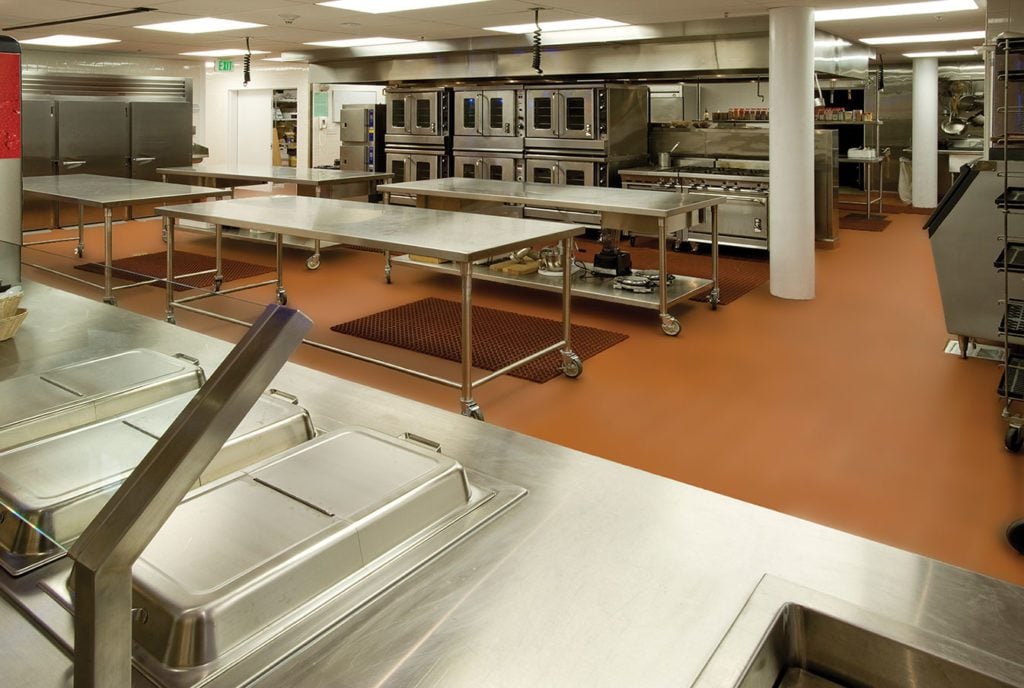
Commercial kitchen floors take more abuse than almost any other floor in a building. Steam cleaning, boiling water spills, dropped equipment, constant foot traffic, and chemical sanitizers all hit the same surface every single day. That surface has to stay hygienic, slip-resistant, and intact through all of it. When the floor is built over a plywood subfloor instead of concrete, the problem gets harder: the wood moves with temperature and humidity changes, seams crack through rigid coatings, and moisture from below can lift a system before the kitchen ever opens.
The Kraftig urethane concrete system was built for exactly this environment. As a commercial kitchen floor coating over plywood, it sticks hard to the substrate, handles the thermal shock of high-temperature cleaning, and produces a dense, seamless surface that won’t support fungus or bacteria growth. The full system installs in 1 to 2 days with zero VOC, which matters in food service, where you can’t close a kitchen over fumes.


Why Commercial Kitchen Floors Over Plywood Need Special Treatment
Health departments require that floors in food preparation areas be smooth, durable, and easy to clean. The FDA Food Code spells this out directly. A floor that cracks, chips, or opens at the plywood joints fails all three, it traps food particles and bacteria, and it gets harder to clean every week it’s left that way.
Plywood subfloors create problems concrete doesn’t have. The panels shift seasonally, and the seams between them are where rigid coatings crack first. Moisture vapor can migrate up through the wood and lift a coating that isn’t designed to handle it. Stack on the thermal cycling of a commercial kitchen, cold water, then steam cleaning, repeated daily, and a standard epoxy system won’t last.
The Kraftig system sticks to properly prepared plywood, handles moisture vapor transmission that would delaminate an epoxy, and moves with the substrate instead of cracking against it. Kraftig SC also meets USDA requirements, which is worth noting for food processing environments where coating materials have to clear regulatory review.
The Kraftig Urethane Concrete System: Layer by Layer
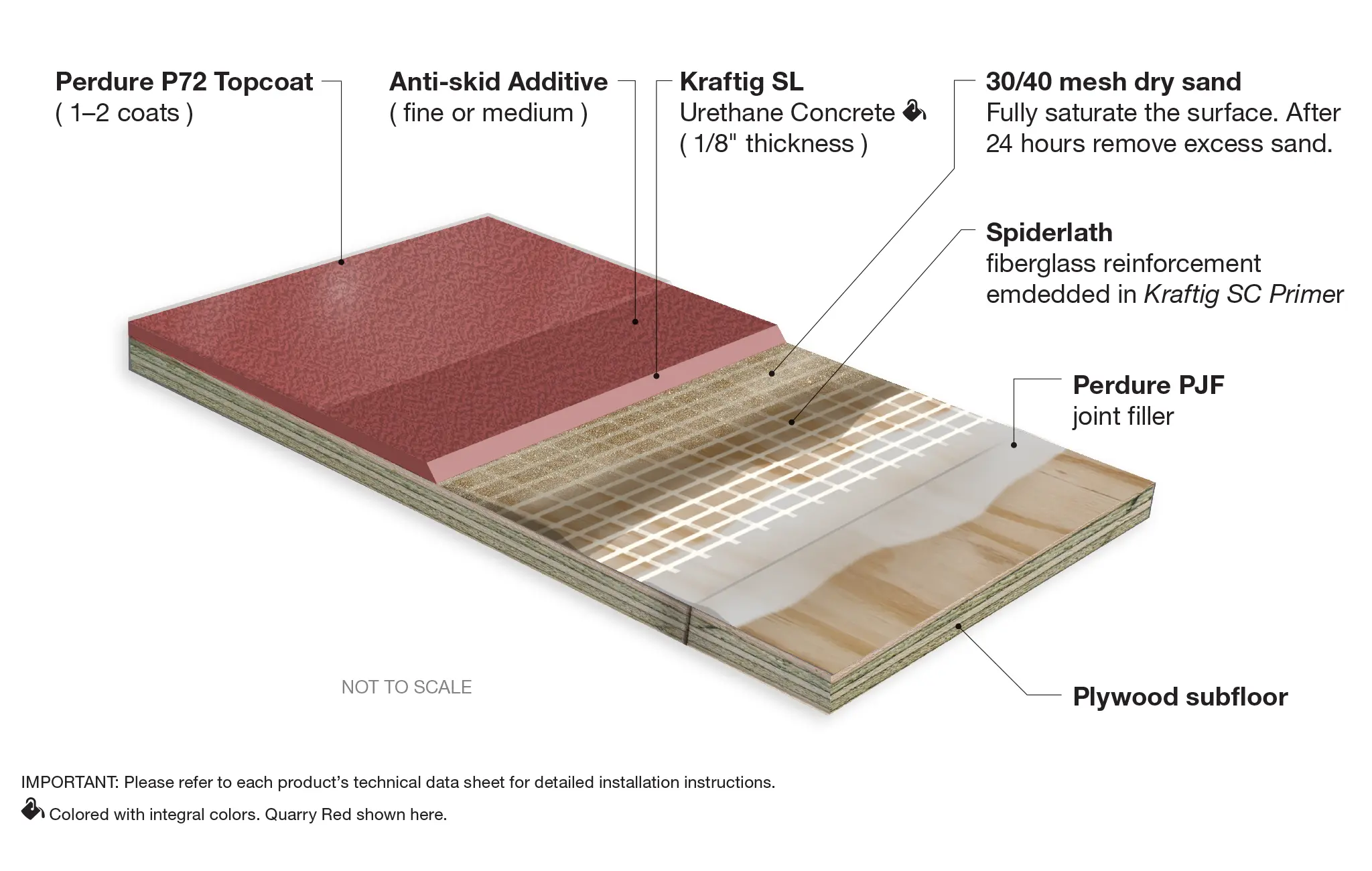
This is a reinforced, multi-layer system. Each layer solves a specific problem with the plywood-over-wood-frame substrate common in commercial kitchen renovations.
Fill and Seal the Plywood Joints
Before any urethane concrete goes down, all plywood seams and fastener holes get filled with Perdure PJF, a flexible joint filler. Don’t skip this step. Without it, the seams telegraph through the finished system as the plywood moves, and no coating will stop that cracking. Fill the joints, let the PJF cure, then proceed.
Fiberglass Reinforcement with Spiderlath and Kraftig SC
Spiderlath fiberglass mesh gets embedded into a wet coat of Kraftig SC, the urethane concrete primer. Spiderlath adds tensile strength across the full floor surface, bridging the plywood joints so they can’t start cracks in the layers above.
Kraftig SC is zero VOC and meets USDA requirements. While it’s still wet, 30/40 mesh sand gets broadcast into the surface to give the Kraftig SL layer above something to grip. Pot life is 8 to 10 minutes, so work in sections. Recoat time is 7 to 8 hours.
Kraftig SL Self-Leveling Urethane Concrete
Kraftig SL is the main body coat, applied at 1/8 inch. This is where the system earns its keep in a commercial kitchen. It handles thermal shock from hot water and steam, won’t support fungus or bacteria growth, and produces a dense, non-porous surface that meets the cleanability standards health inspectors look for. If you’re working over a wood subfloor, this installation guide for self-leveling systems over plywood covers the substrate prep in more detail.
An anti-skid additive can go into the wet surface to provide measurable slip resistance in areas that stay wet: cook lines, dishwashing stations, prep areas near floor drains. OSHA 29 CFR 1910.22 sets walking-working surface standards for general industry, and most commercial kitchen operators specify a minimum slip resistance rating as a matter of course.
Kraftig SL can also be installed with an integral cove base, running the urethane concrete 4 to 6 inches up the wall to create a seamless floor-to-wall transition. That joint at the wall base is where bacteria accumulate and where conventional coatings tend to fail first. In a commercial kitchen, the cove base is worth doing.
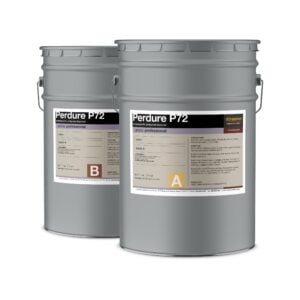
Perdure P72 Polyaspartic Topcoat
Perdure P72 seals the surface. One to two coats of P72 close up the Kraftig SL layer, add chemical resistance, and leave a consistent, cleanable finish. P72 can be applied with an anti-skid additive if more slip resistance is needed on top of what was broadcast into the SL layer.
Urethane Concrete vs. Epoxy: Why Epoxy Doesn’t Hold Up in Commercial Kitchens
Epoxy has been the default commercial kitchen floor coating for decades, and it causes predictable problems in that environment.
The main one is thermal shock. Kitchen floors get cold water, then steam from equipment, then hot sanitizing solution, multiple times a day. Epoxy is rigid and doesn’t handle those temperature swings. It cracks, usually starting at joints and edges, and once cleaning chemicals get underneath, delamination follows quickly. Epoxy floor coatings in restaurants have a well-documented track record of this.
Urethane concrete handles thermal shock because the chemistry works differently. It expands and contracts with temperature instead of fighting it. It also tolerates the moisture vapor transmission that comes with a plywood subfloor, a condition that’s essentially incompatible with epoxy and will cause delamination regardless of how clean the prep work was.
Epoxy also has a stronger odor during installation, which is a real problem in an occupied food service facility. Kraftig SC and Kraftig SL are zero VOC, so installation doesn’t have to wait for a full kitchen shutdown. For a broader look at how urethane concrete performs in food processing environments, this overview covers the category in more depth.
Ready to Spec or Install?
If you’re a contractor or facility manager working on a commercial kitchen in the New York or New Jersey area, Duraamen’s regional teams can help you spec the Kraftig system for your project.
Commercial floor coatings in NYC and commercial floor coatings in New Jersey are both supported by local offices. The Kraftig Urethane Concrete Floor Kit is also available for direct purchase. Contact Duraamen at 1.866.835.6595 or email info@duraamen.com to talk through your project.