
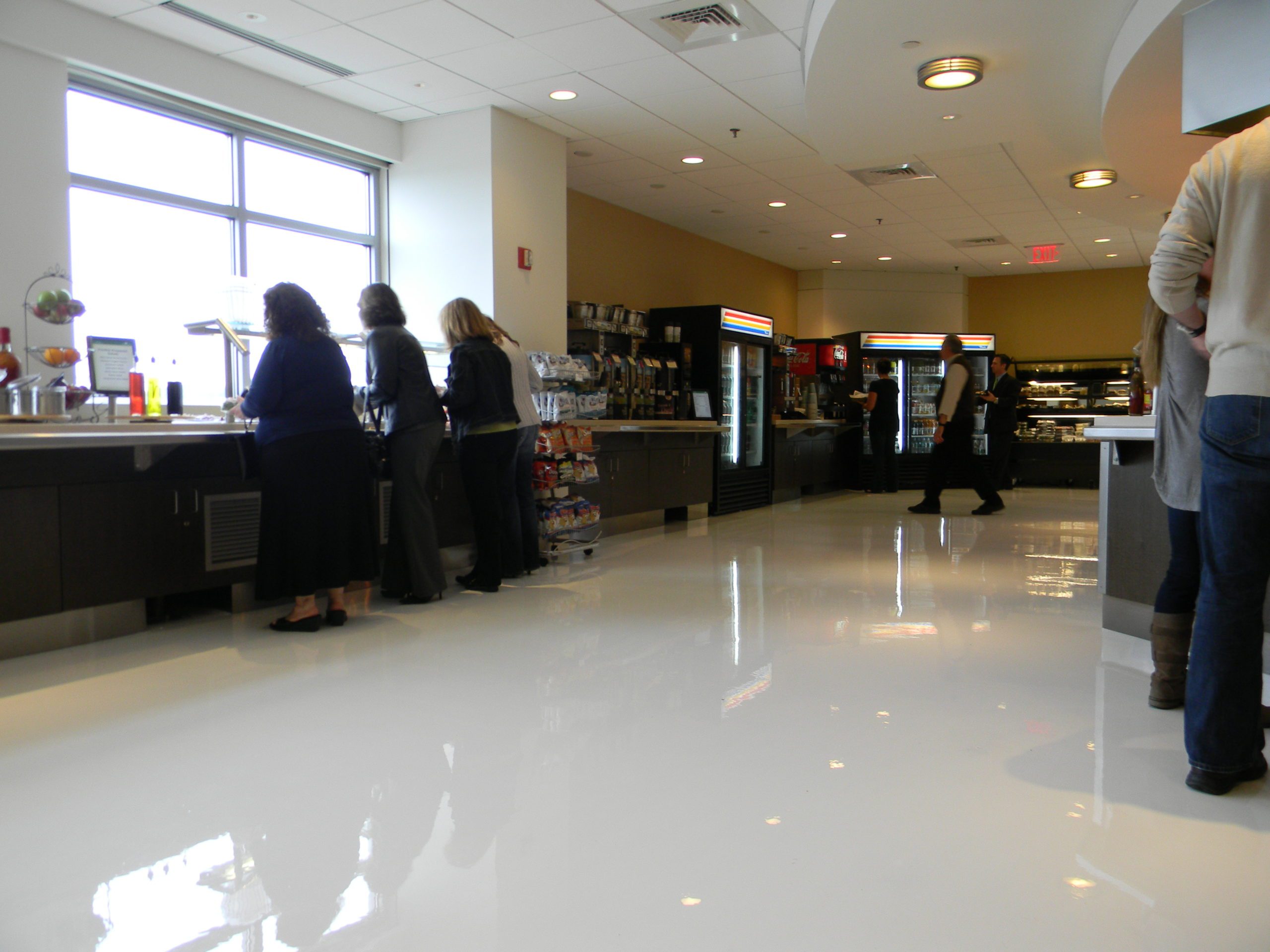
Perdure SLE – New Balance cafe, Boston, MA
The porous surface of concrete flooring allows water and soluble contaminants to penetrate into a structure, which can lead to premature degradation. The degradation of concrete flooring can manifest in efflorescence, laitance and physical defects such as cracking and spalling. Concrete floor coatings can protect it from degradation by providing abrasion, stain, chemical and freeze/thaw protection.
Typical coatings that can be successfully specified and used for concrete floors include acrylics, epoxies, polyurethanes, polyaspartic polyurea and specialized elastomeric coatings. It should be noted that alkyd based coatings should never be specified for application to concrete, since the alkyd resin may chemically react with alkaline concrete compounds and moisture, leading to saponification. This reaction transforms the resin into a soft material that no loner functions as a coating and provides little protection to the concrete substrate.
Acrylic sealers are generally several mils thick and are applied 2 or 3 mills per coat. They are either water based or solvent based compounds. Usually solvent based acrylic sealers are used in exterior applications whereas water based acrylic sealers are used in interior applications. A variety of epoxy coatings can be used for coating concrete. typical epoxies are multi component materials with a polyamide or amine curing agent. Polyamide epoxies are known for possessing better flexibility and water resistance, while amine-cured epoxies typically offer better chemical resistance. Epoxy systems are usually applied in one to three coats at an application thickness of several mils per coat. Thicker-film epoxy coatings, such as those based on epoxy phenol novalac resins are also used on concrete. Novolac epoxies are more often used for the purpose of providing chemical resistance. Epoxy coatings should be topcoated with a finish coat of a different resin chemistry, since they chalk / amber in sunlight. Typically they are coated with polyurethanes.
Polyurethane coatings are widely used as topcoats over acrylics or epoxies due to their higher abrasion and UV resistance properties. They can be blended with cement-sand matrix to create ultra durable polyurethane concrete flooring systems. PU Concrete is know for its quick return to service properties.
If exterior concrete requires greater protection, particularly against water intrusion such as wind driven rain, elastomeric coatings are a good choice. Elastomerics are also a good match for concrete since they can tolerate some substrate movement and may be able to fill or “bridge” minor cracking. Elastomeric are generally thick (10 to 100mils dft), flexible coatings with low water permeability. They are typically used for exterior concrete applications such as building exteriors, roofing systems and parking decks, but can also be considered for interior applications such as showers and spas. Multiple resin chemistry form the basis for the various types of elastomeric coatings, including acrylic, silicone, polyurethane and polyurethane/polyurea hybrid.
Concrete surfaces must be properly prepared before the application of any coatings. Preparation methods may include mechanical abrasion or pressurized water cleaning. Testing for moisture in the concrete may also be warranted, particularly when any previous problems have been observed. Concrete coatings can significantly extend its useful service in many applications. Successful application requires performing the appropriate method of surface preparation and selecting the right type of coating based on performance requirements and service environment.