
Client:
Alex and Ani
High-end Jewelry Retailer
Flagship Store in Providence, RI
Installer:
Madstone Concrete
Tom Zilian
The 2,300 sq.ft. area was completed in 2013.
Products Used:
The Challenge
Create a glamourous high-gloss polished concrete floor for the jewelry retailer, Alex and Ani. Overcome the issue of installing the floor over a soft gypsum-based underlayment at a minimum of expense in time and money.
The Outcome
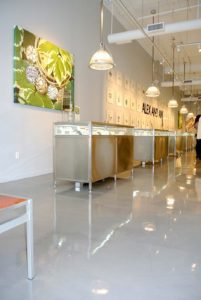
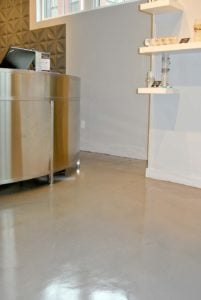
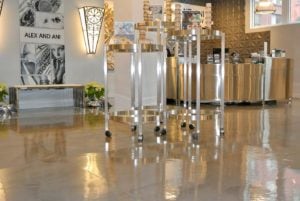
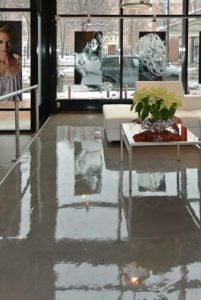
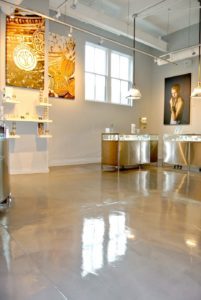
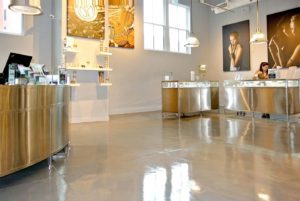
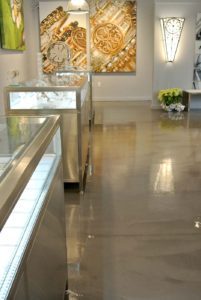
A beautiful high-shine floor is created that fits in the store’s brand colors and really sets off the merchandise. The new floor withstands heavy foot traffic, is easy to maintain and veer low maintenance.



Overview
Madstone Concrete was supposed to polish an existing concrete floor in the flagship retail jewelry store, Alex & Ani. When the installers started grinding the concrete surface in preparation for polishing, the machine started grinding very deep into the surface. Tom Zilian of Madstone realized the substrate was not concrete but was in fact a gypsum-based underlayment. The gypsum was of very good quality, looked like concrete, but was much softer than concrete. On a gypsum-based substrate, the only option for installing a polished concrete floor is to use Skraffino—a cement-based microtopping.
Installation
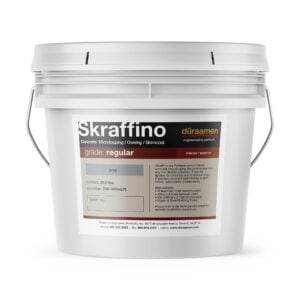
Madstone installed 3 coats of Duraamen’s Skraffino microtopping. The first coat was regular grain Skraffino, followed by fine grain, and lastly, super fine grain. This builds a tough, durable surface that is smooth and ready to accept epoxy coatings and the desired sheen of topcoat. The Skraffino was colored with our Colorfast integral coloring powders.
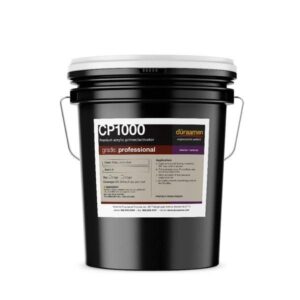
The floor was then sealed and glazed with Perdure E32 and Perdure E12. Our Perdure products are epoxy, polyurethane, and polyaspartic lines of coatings, primers, and sealers engineered for professional-grade concrete flooring projects. There is a wide range of Perdure products to choose from so that no matter what the job requirements are we have a product that will fill the need.
In this case, Perdure E32, a water-based epoxy sealer/primer, was used to ready the surface for the application of Perdure E12. E12 is an epoxy glaze that provides a durable high-shine surface.
Lastly, all of the previous work was sealed with Perdure U50. U50 is a chemically resistant polyurethane topcoat. It provides years of protection from harsh chemical cleaners and heavy foot traffic.
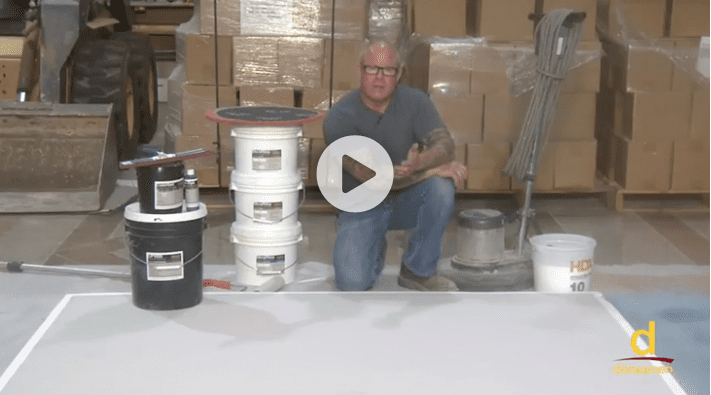
View the Installing Concrete Microtoppings
Over Gypsum video Series
The Success:
The Alex and Ani store in Providence, RI now has an incredible-looking, low-maintenance polished concrete floor in spite of the fact their gypsum subfloor was not able to be polished.
Retail environments require flooring systems that are both visually striking and durable enough to withstand constant foot traffic. Polished concrete floors have become a popular choice for high-end retail stores because they create a sleek, modern appearance while requiring minimal maintenance. In the Alex and Ani flagship store, achieving the desired polished concrete finish presented a unique challenge because the existing substrate was a gypsum-based underlayment rather than a traditional concrete slab.
To solve this problem, a cementitious overlay system—commonly known as microtopping or microcement—was installed to create a new decorative surface over the gypsum floor. Microtoppings and microcement are thin polymer-modified cement coatings that can be applied in very thin layers to transform existing surfaces into seamless decorative concrete floors.
Multiple coats of Skraffino microtopping (microcement) were applied to build a smooth, durable surface that could replicate the appearance of polished concrete. Because microcement overlays can be applied in thin layers, they are ideal for renovation projects where the existing substrate cannot be mechanically polished.
Colorfast pigments were incorporated into the system to complement the store’s design aesthetic while maintaining the natural appearance associated with polished concrete floors. Once the decorative overlay was installed and refined, an epoxy primer was applied to strengthen the system and prepare the floor for the protective topcoat.
The floor was then sealed with a durable polyurethane coating that enhances the polished appearance while protecting the surface from heavy retail foot traffic and daily wear. The finished system creates a beautiful reflective floor that enhances the store’s interior lighting and highlights the jewelry displays.
Polished Concrete Look Over Gypsum or Gypcrete Floors
Many retail spaces, residential buildings, and commercial developments use gypsum underlayments (often called gypcrete) instead of structural concrete slabs. These substrates are commonly used in multi-story buildings because they help level floors and improve sound insulation.
However, gypsum floors cannot be polished like traditional concrete because they lack the hardness required for mechanical grinding and polishing. In these cases, installing a microtopping or microcement overlay is one of the most effective ways to achieve the appearance of polished concrete.
Microcement and microtopping systems can be applied over properly prepared gypsum substrates to create a new cement-based surface that mimics the look of polished concrete. Once installed, the overlay can be colored, sealed, and protected using high-performance coating systems.
This approach allows architects and designers to achieve the aesthetic of polished concrete floors even when the original substrate is gypsum rather than structural concrete.
Why Retail Stores Use Microcement or Microtopping Floors
Microcement and microtopping overlays are increasingly used in retail environments because they offer a combination of aesthetics and performance. These systems allow designers to create seamless, modern floors without removing the existing substrate.
Key advantages include:
• seamless modern appearance
• ability to install over existing floors
• minimal thickness added to the floor
• compatibility with decorative stains and pigments
• durable protective coatings for high-traffic areas
Because of these benefits, microcement and microtopping systems are widely used in retail stores, showrooms, restaurants, and commercial interiors where design flexibility and durability are essential.